
Texturizers Family · 4 SKUs
Texturizers & carriers
The functional backbone of the formula — natural, palm-free emulsifiers, carriers and thickeners that give a product its body, glide and stability, all with batch-level COA documentation.
 Confirm current availabilityTexturizers
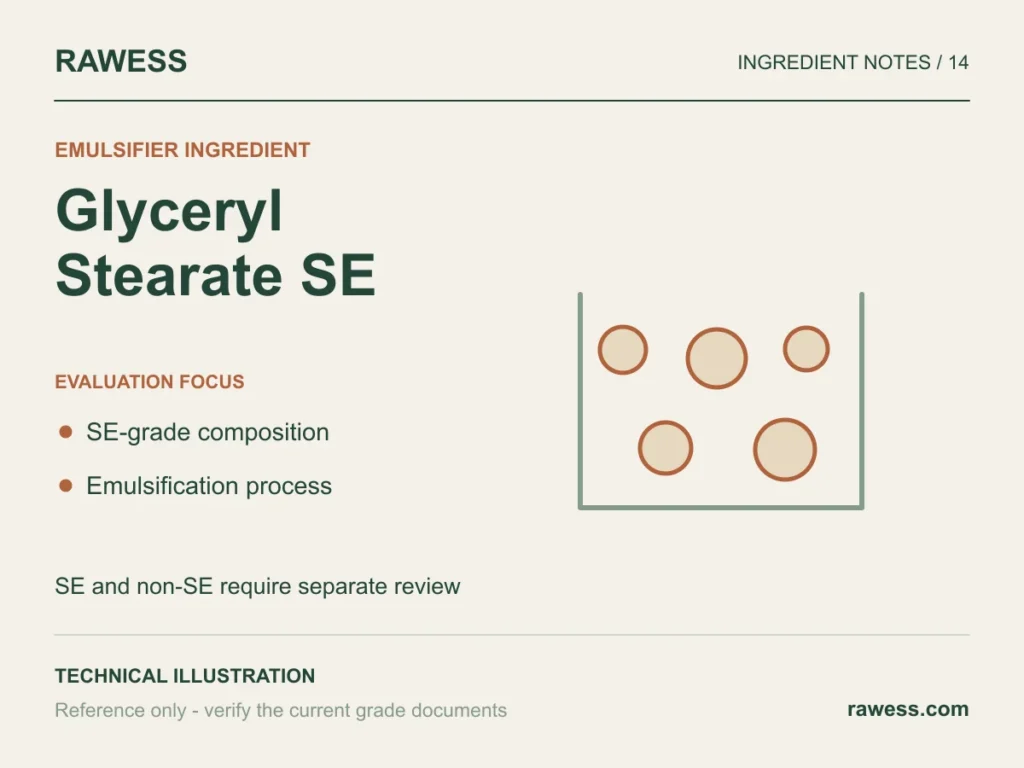
Glyceryl Stearate SE
Glyceryl Stearate SE · CAS 31566-31-1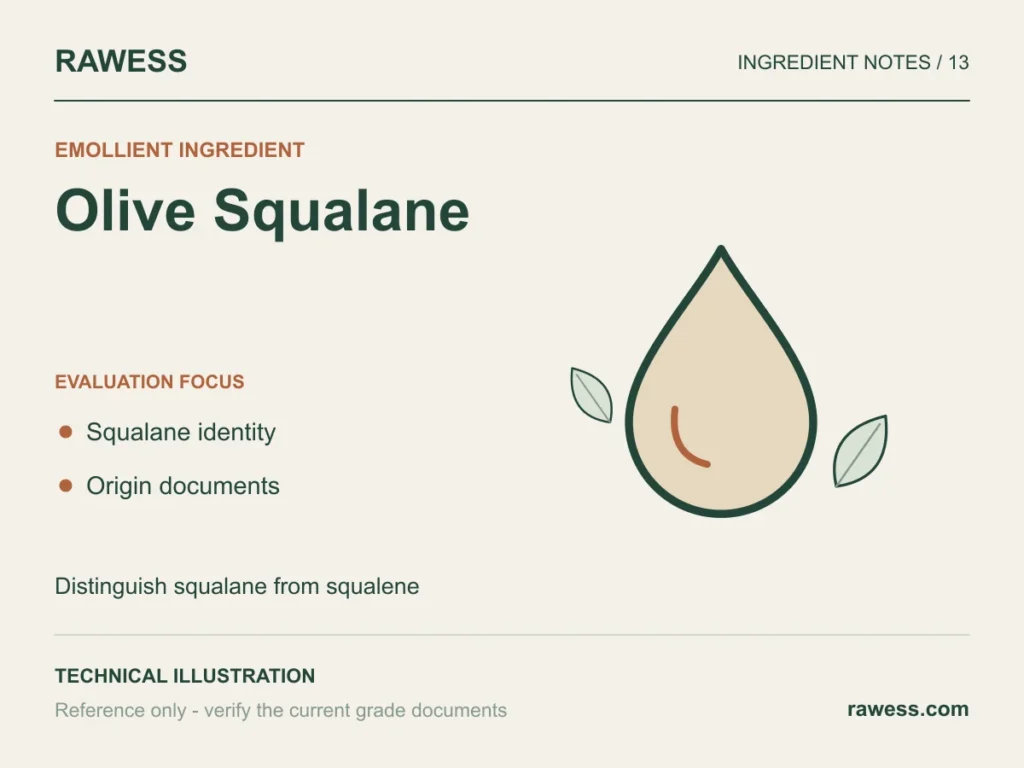 Confirm current availabilityTexturizers
Olive Squalane
Squalane · CAS 111-01-3 Confirm current availabilityTexturizers
Olivem 1000 Type
Cetearyl Olivate / Sorbitan Olivate · CAS Blend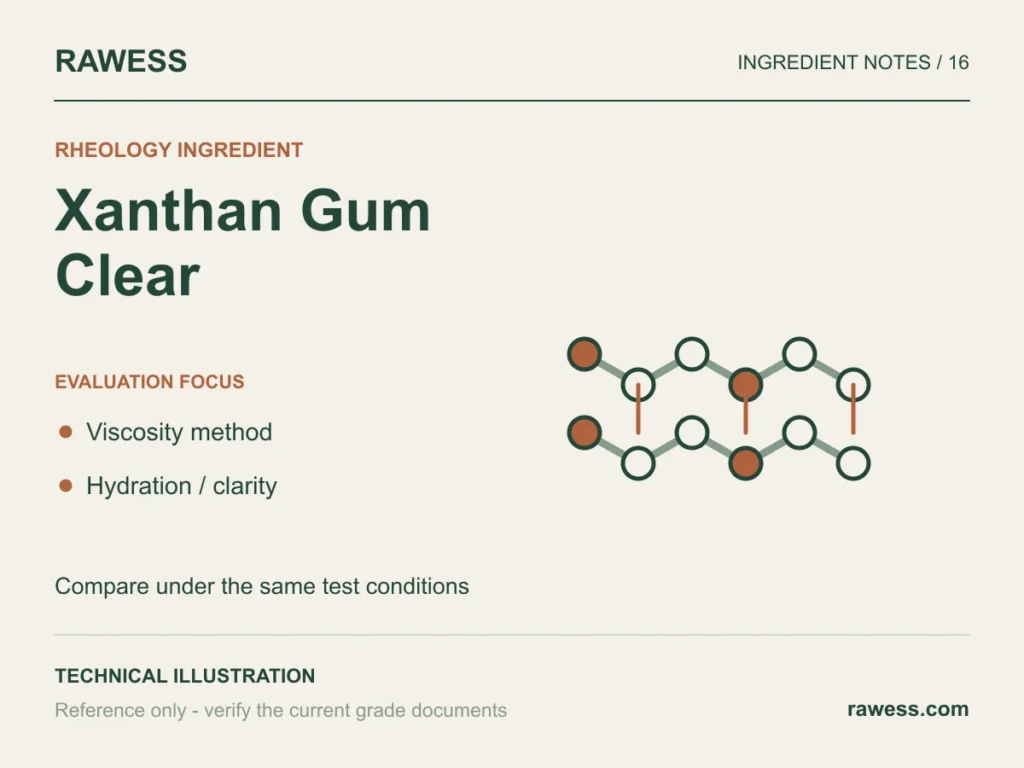 Confirm current availabilityTexturizers
Xanthan Gum Clear
Xanthan Gum · CAS 11138-66-2How to source
Match the carrier to the format.
Texturizers define how a formula performs on the shelf and on the skin — emolliency, emulsification, viscosity and clarity. Choose by the dosage form and the clean-label target.
Olive squalane 99% for lightweight, non-greasy emolliency in serums, oils and moisturizers — olive-derived and COSMOS-eligible.
Olivem 1000-type (cetearyl olivate/sorbitan olivate) delivers a skin-identical, starter-friendly oil-in-water emulsion.
Glyceryl stearate SE for texture and emulsification; clear-grade xanthan gum for suspension and rheology in gels and lotions.
Purchasing questions
Use these answers to prepare qualification and quotation requests. Availability of documents, certifications and commercial options must be confirmed for the offered grade and order.
Can I exchange emulsifiers or thickeners at the same percentage?
Do not assume a one-to-one substitution. Match oil phase, pH, electrolyte load and process; compare viscosity under the same hydration, instrument and shear conditions, then run stability and packaging trials. Ingredient Knowledge Center
Which specification, INCI and CAS identify the grade I am buying?
Match the full supplied composition, INCI, CAS where applicable, physical form and current specification to the quotation. A blend may contain carriers, preservatives or salts. An INCI name alone does not establish concentration, branded origin or interchangeability. Quality and document review
What use level, compatibility guidance and formulation support can I request?
Request the current grade-specific TDS, starting use range and incorporation instructions, plus any application examples available. Disclose pH, processing temperature, phase, electrolytes and other actives. Confirm solubility or dispersion, preservation and packaging in trials; a starting formula is not validation of your finished product. Ingredient Knowledge Center
Are texturizers and polymers affected by the EU microplastics restriction?
Assess the exact supplied polymer under REACH Annex XVII entry 78, introduced by Regulation (EU) 2023/2055. Composition, particle form, dimensions, solubility, degradability, intended use and any applicable derogation or transition matter. Natural origin or an INCI name alone is insufficient. Request a grade-specific assessment and supporting test evidence. Ingredient Knowledge Center · EU restriction on synthetic polymer microparticles
Is this grade vegan or cruelty-free, and which allergen information is available?
Request separate, dated statements for animal-derived inputs, processing aids, animal-testing policy and allergen content or carry-over. Confirm the scope, site and supplied composition. For EU fragrance-allergen assessment, use the applicable expanded Annex III requirements, not only an older 26-allergen checklist. These claims cannot be assumed across the portfolio. Ingredient Knowledge Center · EU fragrance-allergen amendment
Can you provide COSMOS, Ecocert, ISO 9001 or ISO 22716 evidence?
Request the current certificate, holder, site, scope and expiry date for the proposed material or facility. Ingredient approval, an organic certificate and a site management-system certificate serve different purposes. Do not treat a logo or portfolio statement as certification of every ingredient. Quality and document review
Will the supplied batch have a COA with assay, metals and microbiological limits?
Request the lot-specific COA before release and agree the required identity, assay, impurities, heavy metals and microbiological tests. Check actual results, units, methods and acceptance limits; test panels differ by grade. A specification, SDS, TDS or product PDF cannot replace batch analytical results. Quality and document review
Can I buy a trial quantity below the listed MOQ?
Ask about sample sizes, pilot packs or a split pack for the specific grade. Feasibility depends on packaging, handling, traceability and available stock. Confirm quantity, pack size, price, documents and lead time in the quotation; a sample does not establish ongoing supply below MOQ. Request grade-specific documents and a quotation
Selection knowledge and product documents
An emulsifier system and a thickener solve different formulation problems. Compare the proposed grade, test conditions and manufacturing process before using viscosity or ingredient names to choose a replacement.
Selecting Cosmetic Emulsifiers and Thickeners · Download product PDFs · Ingredient Knowledge Center
Technical reading: Cosmetic Emulsion and Viscosity Troubleshooting
Cosmetic Emulsion and Viscosity Troubleshooting — When an emulsion separates or viscosity drifts, isolate the emulsifier, hydration and process variables before increasing the thickener.
Choose a texturizer by process conditions and rheology data
Emulsifiers, emollients, gums and waxes are not interchangeable by INCI alone. Compare acid/peroxide values, HLB or drop point, particle or mesh size, hydration, viscosity method, electrolytes, pH and the phase where the material must work.
- Olivem 1000 Type: confirm active content, HLB basis, drop point, acid/peroxide values and the oil/water process window.
- Glyceryl Stearate SE: compare monoglyceride assay, acid/saponification values, free glycerol, particle form and the target emulsion.
- Xanthan Gum Clear: match mesh size, hydration order, 1% viscosity method, transparency, electrolytes and microbial limits.
- Olive Squalane: review GC assay, peroxide/acid values, colour, plant-origin documentation and oxygen protection.
Use the emulsion and viscosity troubleshooting guide, the solubility and dispersion guide and the raw-material technical data checklist to define the trial. Request the current product PDF, TDS, COA and SDS for the offered grade.