
Peptides Family · 4 SKUs
Cosmetic peptides
Synthesized to pharma-grade batch records: GHK-Cu, argireline, Matrixyl 3000 and tripeptide-1, each with MS sequence confirmation and a method-validated dossier. Ships from bonded Rotterdam stock.
 Confirm current availabilityPeptides
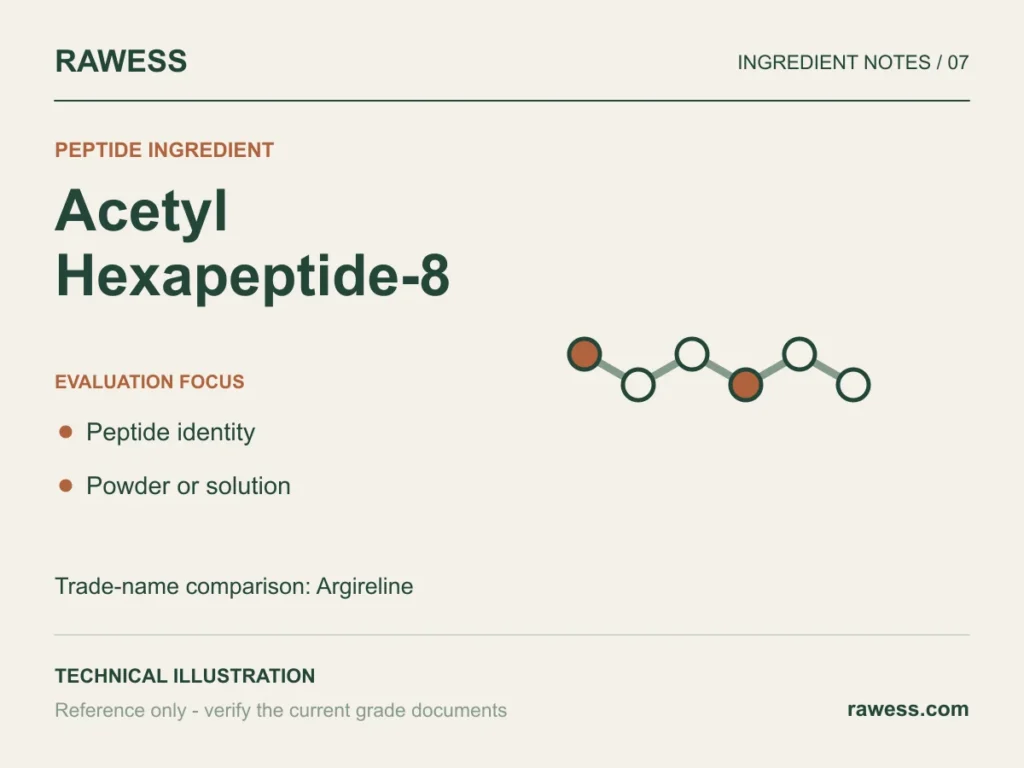
Argireline
Acetyl Hexapeptide-8 · CAS 616204-22-9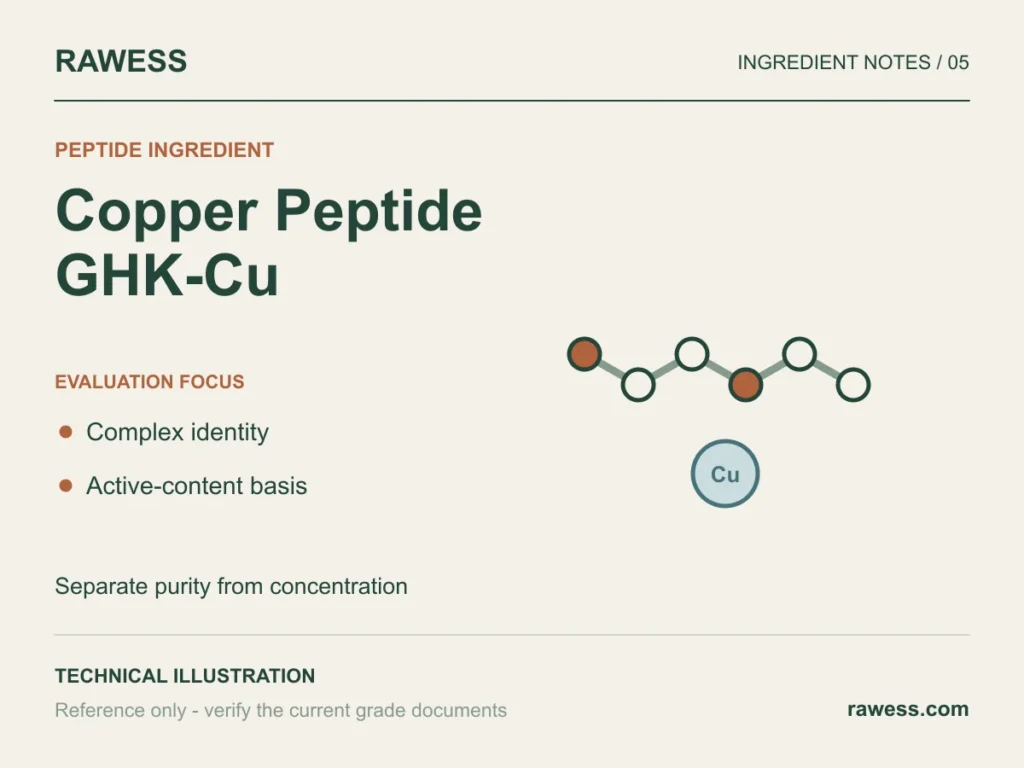 Confirm current availabilityPeptides
Copper Peptide GHK-Cu
Copper Tripeptide-1 · CAS 89025-25-2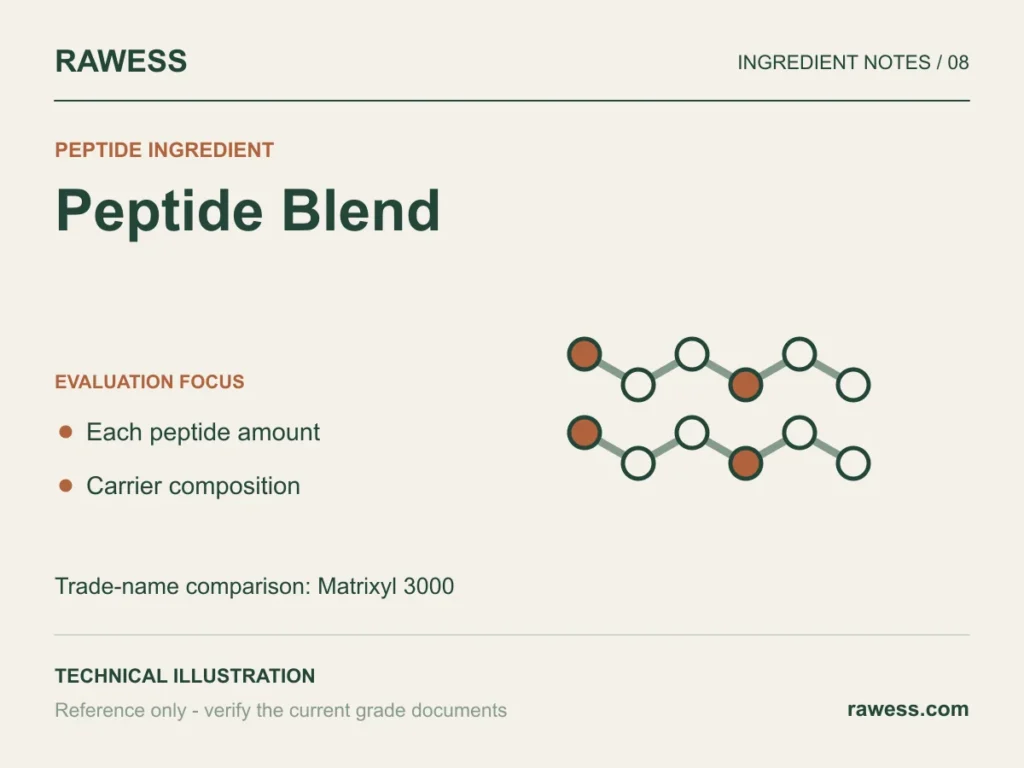 Confirm current availabilityPeptides
Matrixyl 3000 Blend
Palmitoyl Tripeptide-1 / Palmitoyl Tetrapeptide-7 · CAS Blend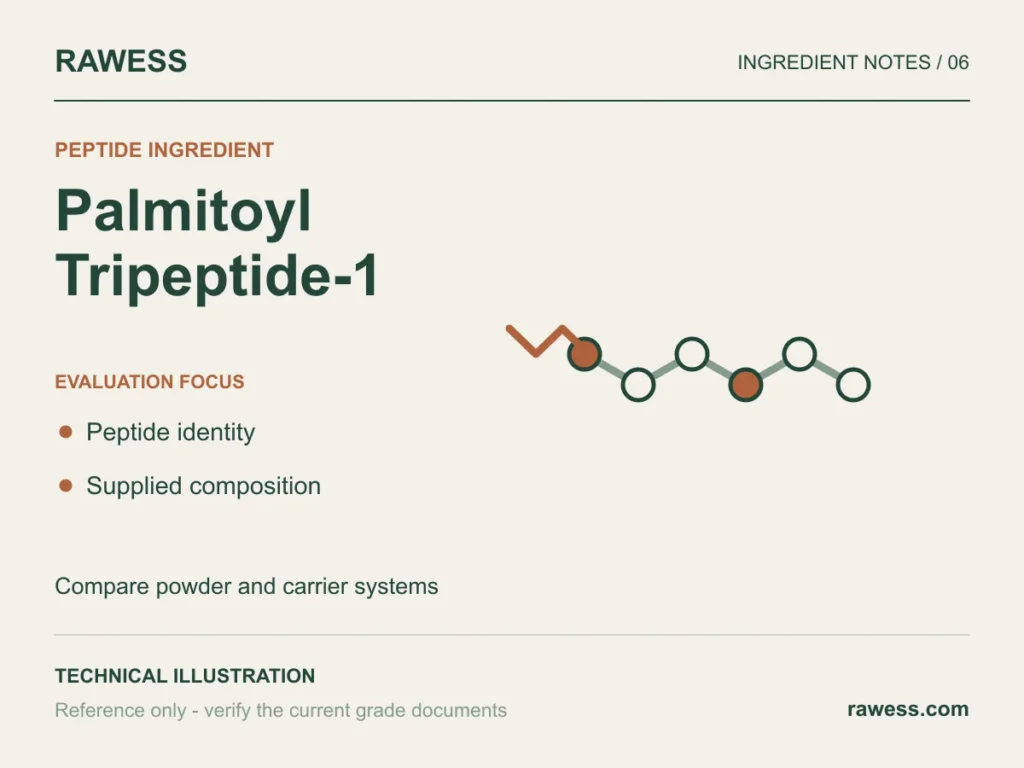 Confirm current availabilityPeptides
Palmitoyl Tripeptide-1
Palmitoyl Tripeptide-1 · CAS 147732-56-7How to source
Pick the peptide by claim & dossier.
Peptide claims live or die on the dossier. Every first order ships the method-validation package — linearity, precision, robustness — the same evidence the 2026 REACH review expects from importers.
Copper peptide GHK-Cu for repair and collagen-firming serums; palmitoyl tripeptide-1 as the classic anti-aging workhorse.
Argireline (acetyl hexapeptide-8) for fine-line targeting in "instant-smooth" claims.
Matrixyl 3000 blend pairs palmitoyl tri- and tetrapeptide in a supplier-agnostic blended peptide matrix.
Purchasing questions
Use these answers to prepare qualification and quotation requests. Availability of documents, certifications and commercial options must be confirmed for the offered grade and order.
Is peptide powder equivalent to a prepared solution?
No. Compare net peptide content as supplied, chromatographic purity, water or salt correction and carriers. Convert the intended active dose before comparing cost or weighing material. Ingredient Knowledge Center
What purity or active content applies, and is the grade USP, EP, JP or FCC?
Ask for the assay method, units and basis: dry basis, as supplied, chromatographic purity or marker content. A product name or typical value does not prove monograph compliance. Specify the required pharmacopoeia and edition, then request evidence for the offered grade and lot. Quality and document review
Will the supplied batch have a COA with assay, metals and microbiological limits?
Request the lot-specific COA before release and agree the required identity, assay, impurities, heavy metals and microbiological tests. Check actual results, units, methods and acceptance limits; test panels differ by grade. A specification, SDS, TDS or product PDF cannot replace batch analytical results. Quality and document review
What use level, compatibility guidance and formulation support can I request?
Request the current grade-specific TDS, starting use range and incorporation instructions, plus any application examples available. Disclose pH, processing temperature, phase, electrolytes and other actives. Confirm solubility or dispersion, preservation and packaging in trials; a starting formula is not validation of your finished product. Ingredient Knowledge Center
What pH, temperature, light and storage stability data should I request?
Ask for grade-specific TDS guidance and any stability data with test conditions, packaging and acceptance criteria. Raw-material shelf life does not establish stability in your formulation. Evaluate processing heat, pH, light, oxygen and packaging in the finished product under your proposed conditions. Ingredient Knowledge Center
Can ingredient efficacy or clinical data support my finished-product claims?
Ask which reports are available and compare material identity, concentration, route, formulation, population and endpoints. In-vitro, oral and topical clinical evidence are not interchangeable. Published research on another material does not prove efficacy of the supplied lot or your formula. Substantiate finished-product claims with relevant evidence. Ingredient Knowledge Center · EU common criteria for cosmetic claims
Is the ingredient suitable for the EU, China, the US or ASEAN?
Share the destination, finished-product category, intended use and concentration. Ask for the grade-specific regulatory status and supporting documents for REACH obligations, China IECIC, US requirements and the ASEAN Cosmetic Directive as relevant. An inventory entry or REACH status alone is not finished-cosmetic approval. Ingredient Knowledge Center · EU Cosmetics Regulation
Can a batch be traced to raw materials and the production line?
Ask which records connect the shipment lot, manufacturer batch, incoming materials, production site, QC release and retained sample. Agree document retention and change-notification expectations. Request traceability evidence for the proposed supply chain rather than assuming identical record access for every ingredient. Quality and document review
Peptide COA verification
A peptide certificate is read differently from a small-molecule certificate: identity has to be demonstrated separately from purity, and the percentage reported is rarely the number you weigh out. What a peptide COA can and cannot show sets out the three bases that get confused — chromatographic purity, assay as supplied and net peptide content — with the line items to require on the certificate and the calculation that connects them.
Read it against the grade actually quoted: calculating cosmetic peptide active concentration converts a purity result into grams of peptide, which is the basis a formulation brief should use.
Matrixyl 3000 supply: what a supplier question should establish
Matrixyl is a brand name, while a supplier search for it usually means one of two different requests: the branded material from its owner, or a palmitoyl tripeptide-1 and palmitoyl tetrapeptide-7 blend offered against a stated composition. Those are different documents, and a supplier answer should say which one is on the table.
Branded material and blend reference are not the same offer
The RAWESS catalogue entry is a peptide blend reference, described by its INCI components rather than as the branded article. A blend listing does not establish branded origin, an identical ratio or equivalent performance. Where the specification matters, ask for the composition in mass units and for the basis of any stated ratio.
What to request with a blend quotation
- The mass of each peptide per unit of supplied material, and how any stated ratio was determined.
- The identity and assay method for each component, with the chromatographic conditions named.
- Carrier, counter-ion and residual solvent information for the grade on offer.
- The lot-linked COA, SDS and TDS, plus the storage condition the stability data refers to.
- The order minimum, synthesis slot and lead time for the quantity you intend to buy.
Commercial reference for this blend
| Item | Catalogue value |
|---|---|
| INCI | Palmitoyl Tripeptide-1, Palmitoyl Tetrapeptide-7 |
| Supplied form | White lyophilized powder |
| Storage and shelf life | 2-8 °C, 24 months in the sealed pack |
| Order minimum | 0.5 kg |
| Lead time | 10-14 days against a synthesis slot |
| Packaging | 0.5 kg or 1 kg foil bag, cold chain |
| Terms | FOB, CIF or DDP |
These are catalogue reference entries, not a reserved lot or a standing price. Confirm the specification for the grade on offer before a sample is released.
Related reading: calculating cosmetic peptide active concentration converts a purity result into grams of peptide, and powder versus solution covers the supplied-form comparison. For the ordering side, see the cosmetic raw material buying guide.
Selection knowledge and product documents
Comparing peptide powders and solutions by weight can hide a large difference in active content. Start with peptide identity, analytical basis and the full composition supplied to your lab.
Cosmetic Peptide Powder vs Solution: How to Compare · Download product PDFs · Ingredient Knowledge Center
Technical reading: Calculating Cosmetic Peptide Active Concentration
Calculating Cosmetic Peptide Active Concentration — A powder purity result and a solution concentration are different inputs; establish the active mass basis before calculating a peptide addition.
Compare peptides on identity and active basis
Peptide products that share a family label can still differ by sequence, salt or counter-ion, water, carrier, net peptide content and supplied form. Separate chromatographic purity from the active mass you will add to the formula, then tie the result to a lot COA and storage record.
- Copper Peptide GHK-Cu: verify sequence by MS, copper content by a defined method, acetate residual, net active basis and cold storage.
- Argireline: compare HPLC purity, sequence identity, counter-ion, water, net peptide content and the 2–8°C handling plan.
- Matrixyl 3000 Blend: request the amount of each peptide fraction, blend ratio, carrier and supplied concentration rather than comparing blend weight alone.
- Palmitoyl Tripeptide-1: confirm sequence, truncated sequences, counter-ion, water and the method used for the purity result.
Use the peptide active-concentration calculation, the powder-versus-solution guide and the raw-material technical data checklist before comparing price. Request the current product PDF, lot COA, SDS and TDS separately.