
Texturizers · CAS 31566-31-1
Glyceryl Stearate SE
INCI: Glyceryl Stearate SE
Buyer question
What should you confirm before buying this ingredient?
Confirm the supplied form, assay basis, storage, intended use and the current lot documents before comparing a quote. The same questions should travel from the search result to the product page, sample and release decision.
Which documents should I request first?+
Start with the grade-specific TDS and the lot COA; add the current SDS, product PDF and sample record for the review file.
How should I compare two offers?+
Match identity, supplied form, assay basis, packaging, MOQ, lead time and acceptance tests before comparing price.
Glyceryl stearate SE is a self-emulsifying ingredient used in cosmetic emulsion development. Selection should consider the precise grade composition and its compatibility with the oil phase and processing plan.
| INCI name | Glyceryl Stearate SE |
|---|---|
| CAS number | 31566-31-1 |
| Product family | Texturizers |
| MOQ | 180 kg |
| Lead time | 5-7 days (stock) |
| Packaging | 180kg steel drum / 25kg bag |
| Shipping | FOB · CIF · DDP |
| HS code | HS 3402.13 |
| Origin | Rapeseed chemistry · EU |
| Storage | Ambient |
| Assay (monoglyceride) | ≥ 90% SE grade |
| Appearance | White beads / flakes |
| Shelf life | 24 months |
| Applications | Topical cosmetic formulation evaluation; confirm grade-specific incorporation guidance in the current TDS. |
Download product details
Save the English product guide for ingredient identity, catalog specifications and purchasing checks.
Download product PDF (English) →
For the analytical results of a supplied lot, request the current batch COA separately.
Glyceryl Stearate SE: grade selection
Glyceryl stearate SE is a self-emulsifying ingredient used in cosmetic emulsion development. Selection should consider the precise grade composition and its compatibility with the oil phase and processing plan.
Requirements for your sample brief
- Obtain the complete grade description and distinguish self-emulsifying grades from non-SE glyceryl stearate.
- Review the relevant compositional and physical specifications with their methods.
- Assess heating, mixing, pH, electrolytes and emulsion stability in the complete formulation.
Glyceryl Stearate SE vs Non-SE Glyceryl Stearate
| Compare | Glyceryl Stearate SE / Non-SE Glyceryl Stearate |
|---|---|
| Selection criterion | The self-emulsifying grade has a different functional composition; do not assume the same emulsifier package or processing behavior. |
Related materials for comparison: Olivem 1000 Type and Xanthan Gum Clear. Evaluate each grade independently in your intended system.
Technical specification
B2B supply terms
Documents, samples and quotation
Request the current batch COA, SDS and TDS for the grade under review. Include your formula format, destination market, trial quantity and acceptance criteria; confirm order minimum, packaging, availability and delivery terms for the proposed order.
Use the cosmetic raw material buying guide to compare documents, or explore the ingredient knowledge center and related ingredient family.
Cosmetic Emulsion and Viscosity Troubleshooting
Cosmetic Emulsion and Viscosity Troubleshooting — When an emulsion separates or viscosity drifts, isolate the emulsifier, hydration and process variables before increasing the thickener.
Cosmetic Raw Material Sample Evaluation and Quotation
Cosmetic Raw Material Sample Evaluation and Quotation — Compare samples and quotations on the same grade, composition and acceptance criteria before deciding which offer has the lower usable cost.
Grade review and document trail.
Use the product page to review the supplied form, specification and B2B terms. Then connect the catalogue record to the current documents and sample checks for the grade you are evaluating.
Stability review for this grade.
Raw-material shelf life does not prove stability after dilution, heating, pH adjustment, emulsification or filling. Carry the grade-specific storage and transport conditions into a finished-formula trial, and record the package used.
- pH and phase
- Heat and time
- Light and oxygen
- Packaging and closure
Read the storage and stability guide · Screen solubility and dispersion · Check raw-material technical data · Download the product PDF
Prepare a comparable sample and pilot brief.
A sample is useful when the material, process and acceptance test are defined before dispatch. Send the target use, formula format, destination and trial quantity so the sample, quotation and documents can be matched to the same grade.
- Sample identity and lot
- Trial quantity and package
- Formula phase, pH and process
- Acceptance tests and control
Read the sample evaluation and quotation guide · Compare MOQ, lead time and delivery terms · Request the product PDF and controlled lot documents
Market-specific compliance route.
A raw-material COA, SDS, TDS or product PDF supports qualification; it does not approve a finished cosmetic in every market. Confirm the responsible company, current ingredient restrictions, safety file, label and notification duties for the country where the finished product will be sold.
| Market | Confirm | Evidence boundary |
|---|---|---|
| EU | Check the responsible person, CPSR/PIF, CMR and restricted-ingredient status, INCI label and CPNP notification. | Supplier documents are inputs to the finished-product assessment, not a CPSR or notification. |
| United States | Check MoCRA facility and product-listing duties, safety substantiation, adverse-event process and cosmetic labeling. | A supplier certificate does not replace the responsible person’s safety substantiation. |
| China | Check NMPA classification, ingredient catalogue status, registrant or filer, safety assessment and Chinese label. | Imported raw-material paperwork does not establish NMPA filing or finished-product approval. |
| ASEAN | Check the ACD notification route, local responsible company, INCI/label rules and country-specific restrictions. | A certificate used in one ASEAN market does not automatically satisfy every member country. |
Use the quality and document review · Review the product PDF and lot documents · Use the raw-material technical checklist
Supply continuity and release controls.
MOQ, lead time and stock labels describe a quote snapshot. For repeat orders, confirm how the offered lot connects to its source, retained sample, storage record and change notices before you promise a launch date.
- Availability and lead time for the quoted grade and quantity
- Warehouse, temperature and transport controls for the route
- Lot number linked to COA, packing list and retained sample
- Second-source or change-control plan for a critical ingredient
- Quality agreement: specifications, deviations, complaints and document updates
Read the cosmetic raw-material buying guide · Review quality and document controls · Match the specification to the lot · Keep the product PDF as catalogue context
Same family
Related ingredients.
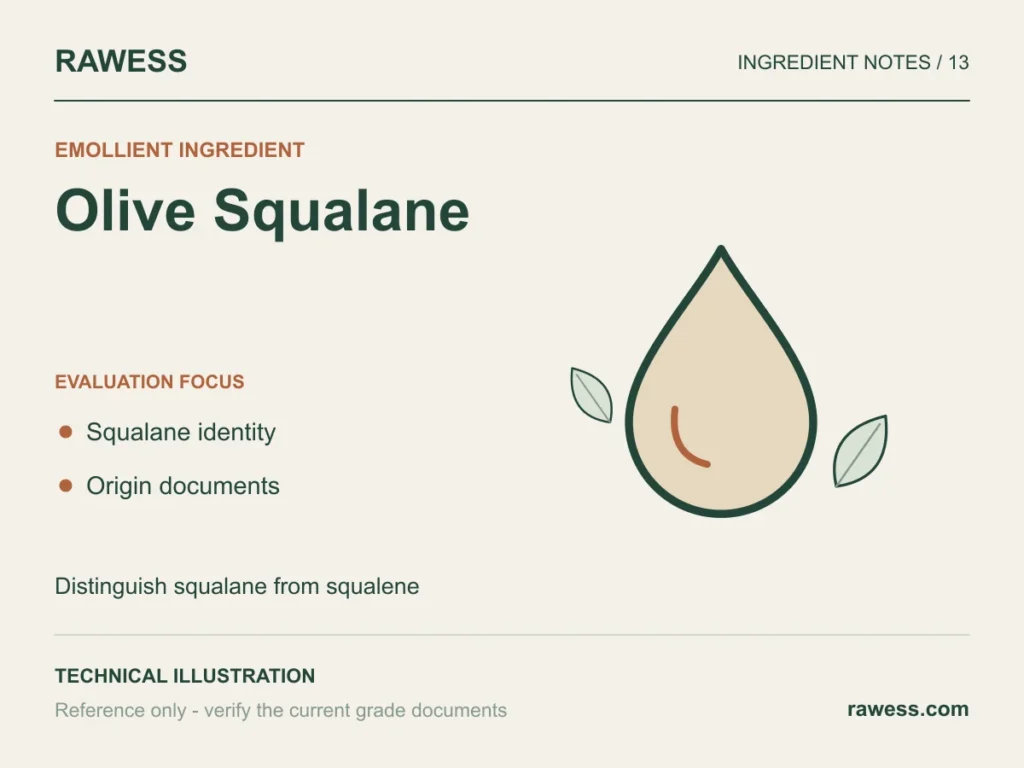 Confirm current availabilityTexturizers
Olive Squalane
Squalane · CAS 111-01-3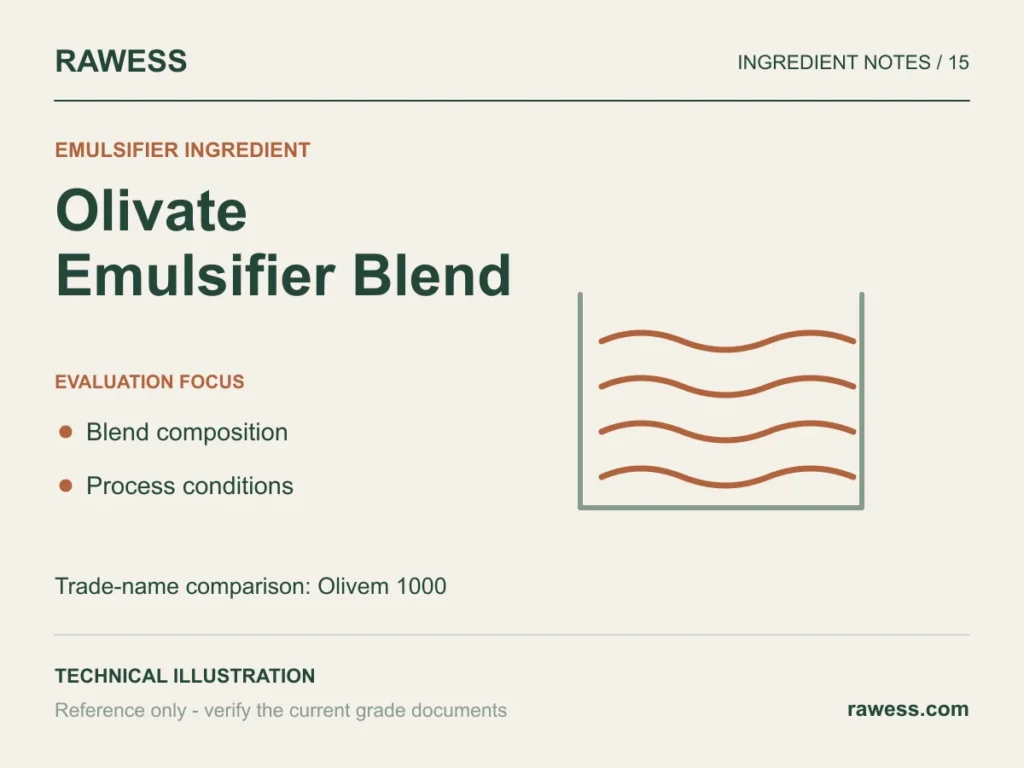 Confirm current availabilityTexturizers
Olivem 1000 Type
Cetearyl Olivate / Sorbitan Olivate · CAS Blend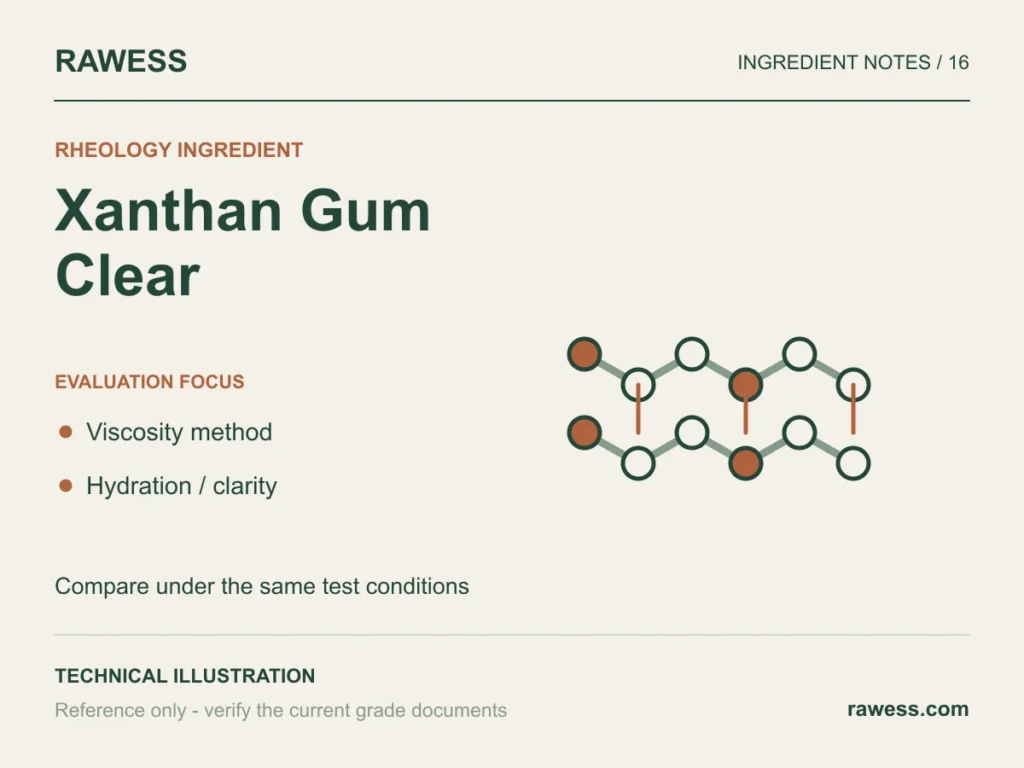 Confirm current availabilityTexturizers
Xanthan Gum Clear
Xanthan Gum · CAS 11138-66-2Product FAQ.
Does SE remove the need for a formulation trial?
No. The complete oil phase, co-emulsifiers, pH, electrolytes and processing affect the emulsion. Qualify the intended formulation and packaging.
Which identity and purchasing references are listed for Glyceryl Stearate SE?
The catalogue currently lists INCI: Glyceryl Stearate SE; CAS: 31566-31-1; MOQ: 180 kg; lead time: 5-7 days (stock). These are reference entries, not a reserved lot or delivery promise. Confirm the current specification, active-content basis and quotation before approval. Request grade-specific documents and a quotation
Will the supplied batch have a COA with assay, metals and microbiological limits?
Request the lot-specific COA before release and agree the required identity, assay, impurities, heavy metals and microbiological tests. Check actual results, units, methods and acceptance limits; test panels differ by grade. A specification, SDS, TDS or product PDF cannot replace batch analytical results. Quality and document review
What use level, compatibility guidance and formulation support can I request?
Request the current grade-specific TDS, starting use range and incorporation instructions, plus any application examples available. Disclose pH, processing temperature, phase, electrolytes and other actives. Confirm solubility or dispersion, preservation and packaging in trials; a starting formula is not validation of your finished product. Ingredient Knowledge Center
Can ingredient efficacy or clinical data support my finished-product claims?
Ask which reports are available and compare material identity, concentration, route, formulation, population and endpoints. In-vitro, oral and topical clinical evidence are not interchangeable. Published research on another material does not prove efficacy of the supplied lot or your formula. Substantiate finished-product claims with relevant evidence. Ingredient Knowledge Center · EU common criteria for cosmetic claims
Is this grade vegan or cruelty-free, and which allergen information is available?
Request separate, dated statements for animal-derived inputs, processing aids, animal-testing policy and allergen content or carry-over. Confirm the scope, site and supplied composition. For EU fragrance-allergen assessment, use the applicable expanded Annex III requirements, not only an older 26-allergen checklist. These claims cannot be assumed across the portfolio. Ingredient Knowledge Center · EU fragrance-allergen amendment
Is the ingredient suitable for the EU, China, the US or ASEAN?
Share the destination, finished-product category, intended use and concentration. Ask for the grade-specific regulatory status and supporting documents for REACH obligations, China IECIC, US requirements and the ASEAN Cosmetic Directive as relevant. An inventory entry or REACH status alone is not finished-cosmetic approval. Ingredient Knowledge Center · EU Cosmetics Regulation
Can I buy a trial quantity below the listed MOQ?
Ask about sample sizes, pilot packs or a split pack for the specific grade. Feasibility depends on packaging, handling, traceability and available stock. Confirm quantity, pack size, price, documents and lead time in the quotation; a sample does not establish ongoing supply below MOQ. Request grade-specific documents and a quotation
Do you accept T/T, L/C or credit terms, and can prices be fixed for 12 months?
Ask for the payment options offered for your order. Deposit, balance milestones, bank charges, L/C conditions and any credit approval must be agreed in writing. A 12-month price or capacity commitment needs an accepted contract specifying volumes, validity, adjustment clauses and cancellation terms; it is not a standard portfolio guarantee. Request grade-specific documents and a quotation
Can a batch be traced to raw materials and the production line?
Ask which records connect the shipment lot, manufacturer batch, incoming materials, production site, QC release and retained sample. Agree document retention and change-notification expectations. Request traceability evidence for the proposed supply chain rather than assuming identical record access for every ingredient. Quality and document review
Are texturizers and polymers affected by the EU microplastics restriction?
Assess the exact supplied polymer under REACH Annex XVII entry 78, introduced by Regulation (EU) 2023/2055. Composition, particle form, dimensions, solubility, degradability, intended use and any applicable derogation or transition matter. Natural origin or an INCI name alone is insufficient. Request a grade-specific assessment and supporting test evidence. Ingredient Knowledge Center · EU restriction on synthetic polymer microparticles
Does the downloadable product PDF replace the batch COA?
No. The watermarked product guide is a reusable reference, not a batch release certificate. Match the offered lot to its current COA, SDS and TDS. Download product guides (English)